
The search for the top machine tending robot manufacturers worldwide requires more than comparing sales figures. A dependable evaluation should examine engineering experience, robot reliability, integration support, and long-term service quality. Machine tending robot systems now support CNC machining, injection molding, press operations, and other repetitive production tasks. Their value appears on the factory floor, where a robot loads a metal blank, removes a finished part, and repeats the cycle with consistent timing.
Performance depends on more than the robot arm. Gripper design, vision systems, safety controls, programming, and machine compatibility can determine the final result. Leading manufacturers often provide complete solutions, including simulation tools, operator training, spare parts, and technical assistance. These details matter when a production line runs through several shifts and a small delay affects delivery schedules.
The manufacturers discussed in this outline represent different strengths, markets, and automation approaches. Some focus on compact systems for small workshops. Others develop high-speed platforms for demanding industrial environments. No ranking is permanently correct. Product updates, regional support, and customer requirements can change the comparison. Public information may also overlook installation quality or actual maintenance performance. That limitation deserves attention.
Readers should therefore assess each company through practical evidence. Look for documented cycle times, payload data, safety certifications, integration examples, and customer feedback from similar industries. A polished brochure is not enough. The best choice should fit the machine, workforce, floor space, and future production plans. This guide offers a structured starting point, while encouraging buyers to verify technical claims before making a serious investment.
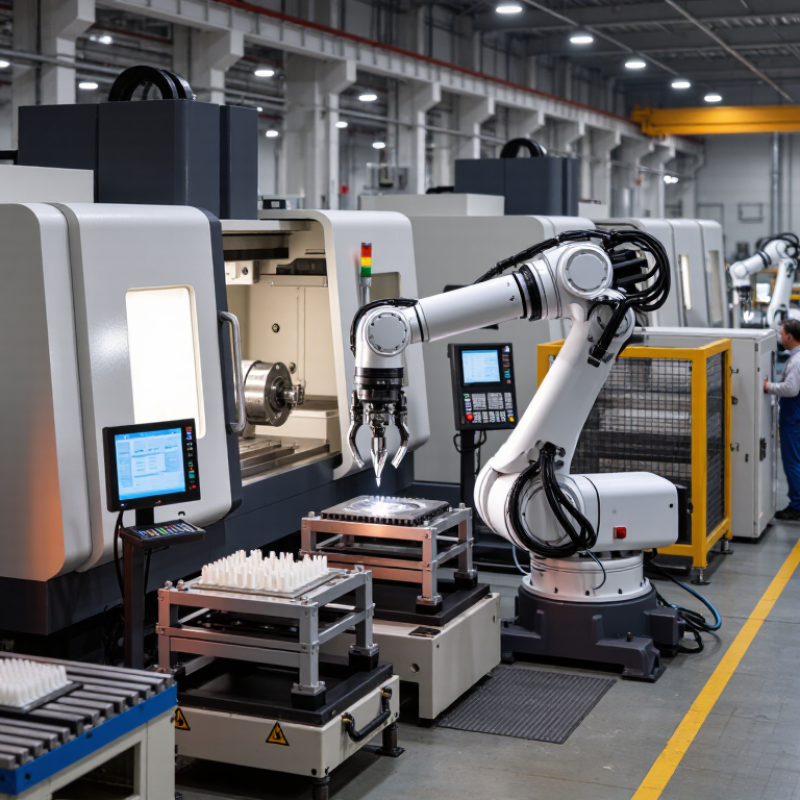
A machine tending robot is an industrial robot that loads and unloads parts from production equipment. It commonly serves CNC machines, press brakes, lathes, and inspection stations. Instead of replacing the machine tool, it manages the repetitive movement around it.
A typical cell includes a robotic arm, gripper, safety enclosure, part fixtures, and control software. The robot removes a finished component, places it in a tray, and loads raw material into the machine. Sensors confirm part presence and door position. Programmers also define approach angles, gripping force, and cycle timing. These details matter. A small alignment error can damage a fixture or stop production.
In practical factories, machine tending improves consistency and reduces exposure to heat, chips, and repetitive handling. It can also support overnight production when the cell includes reliable monitoring and material storage. However, automation is not magic. Poorly designed fixtures still create defects, and a robot cannot solve unclear process requirements. Engineers should test part variation, tool wear, access space, and emergency procedures before installation. Maintenance teams need training as well. A forgotten sensor calibration may cause hours of downtime. The best system is not always the fastest one; it is the one that operates safely, communicates clearly, and remains manageable after the integrator leaves. That point deserves more attention.
Top Machine Tending Robot Manufacturers Worldwide?
Machine tending robots are reshaping modern manufacturing by handling repetitive loading and unloading tasks. A robot can move parts between a machining center, inspection station, and pallet with consistent timing. According to the International Federation of Robotics’ World Robotics 2024 report, 541,302 industrial robots were installed worldwide in 2023. More than 4.28 million industrial robots were operating globally. These figures show strong automation demand, but installation numbers alone do not guarantee productivity.
In practical workshops, machine tending robots reduce direct exposure to hot surfaces, sharp edges, and repetitive lifting. They also support stable cycle times during extended production shifts. Proper integration requires accurate grippers, reliable part detection, guarded work zones, and clear recovery procedures. The International Federation of Robotics identifies manufacturing as the leading industrial robotics sector, reflecting this growing operational role. Small details matter. A poorly designed fixture can make an advanced robot inefficient.
Labor shortages increase the pressure to automate routine work. The World Economic Forum’s Future of Jobs Report 2023 found that 44% of workers’ skills may be disrupted by 2027. Machine tending can help employees move toward programming, quality control, and maintenance. However, training is often underestimated. Some systems still need frequent human intervention because of inconsistent raw materials or tool wear. That is an uncomfortable limitation. Manufacturers should measure actual uptime, changeover time, and operator feedback before expanding automation across the factory.
Top Machine Tending Robot Manufacturers Worldwide?
Comparing global machine tending robot manufacturers requires more than checking payload and price. The International Federation of Robotics reported 541,302 new industrial robots were installed worldwide in 2023. This scale shows a mature market, but supplier quality still varies considerably. Buyers should examine reach, repeatability, cycle-time stability, and compatibility with existing CNC controls. A robot that reaches every corner of a machine may still struggle with heavy doors or irregular workholding.
Service capability matters just as much. Compare local engineers, spare-parts availability, training hours, and remote diagnostic procedures. Ask for documented uptime from similar metalworking applications. The Deloitte 2024 Smart Manufacturing and Operations Survey found that 86% of manufacturing leaders view smart manufacturing as a key competitiveness driver within three years. That expectation makes integration support a commercial requirement, not a pleasant extra.
Look closely at safety validation and programming access. Request evidence of risk assessments, guarding performance, and compliance with applicable machinery standards. A practical trial should measure loading time, tool-change interference, rejected parts, and recovery after a fault. Do not trust a perfect demonstration. It may use unusually cooperative parts. Total cost should include grippers, vision systems, integration, maintenance, and operator training. My own comparison would remain cautious: the cheapest proposal can become expensive when software changes require outside specialists. Keep the test honest.
A practical comparison framework for evaluating machine-tending robot suppliers. The weighting model focuses on the factors most commonly reviewed in industrial automation projects, including performance, integration, safety, service, and lifecycle cost. It does not represent market share or company-specific performance.
Performance should be validated against the actual machine-tending application. Payload and reach must cover the workpiece, gripper, and tooling; repeatability should be assessed using recognized robot performance methods such as ISO 9283. Safety and collaborative-operation requirements should be reviewed with applicable standards, including ISO 10218 and ISO/TS 15066 where relevant.
Leading machine tending robot manufacturers worldwide combine robotic hardware with practical production knowledge. Their systems often serve CNC mills, lathes, press brakes, and automated inspection cells. Strong manufacturers provide payload calculations, reach studies, gripper design, and cycle-time testing before installation. They also understand coolant, metal chips, vibration, and irregular part surfaces.
Factory trials matter. A reliable supplier should test the robot with representative parts, fixtures, and door-opening sequences. Engineers should document loading accuracy, recovery procedures, guarding, and operator training. Regional service teams can reduce downtime when a sensor fails or a gripper needs adjustment. Clear manuals and spare-parts planning also show professional maturity. Look for measurable evidence, not impressive promises.
The best manufacturers adapt systems to different factory sizes and workforce skills. Modular cells can help smaller plants start with one machine. Larger facilities may require coordinated robots, conveyors, and production software. However, no design fits every line. Early cycle-time estimates can be too optimistic. Real chips, tool changes, and part variation often expose hidden delays. A careful manufacturer admits these limits and revises the design after trials. That honesty may be more valuable than a polished demonstration. Availability, safety documentation, integration experience, and long-term support should guide the final decision.
Non-branded comparison of the principal global machine-tending robot segments and their commonly published technical characteristics
| Manufacturer Segment | Typical Robot Configuration | Typical Payload | Typical Reach | Repeatability | Typical Machine-Tending Tasks | Key Integration Features | Common Industries |
|---|---|---|---|---|---|---|---|
| Collaborative robot manufacturers | Six-axis collaborative articulated robot | 5–25 kg | 0.8–1.9 m | ±0.02–0.05 mm | CNC loading, unloading, inspection, deburring and pallet transfer | Force limiting; hand-guiding; rapid setup | General manufacturing, electronics, medical devices |
| General-purpose industrial robot manufacturers | Six-axis articulated industrial robot | 10–250 kg | 1.4–3.2 m | ±0.02–0.08 mm | High-volume CNC tending, forging, casting, welding and heavy-part handling | High speed; high duty cycle; safety-cell integration | Automotive, metalworking, machinery, aerospace |
| Compact articulated robot manufacturers | Four- or six-axis compact robot | 3–20 kg | 0.5–1.5 m | ±0.015–0.05 mm | Small CNC machines, turning centers, assembly and part sorting | Small footprint; flexible mounting; vision compatibility | Precision machining, electronics, consumer goods |
| SCARA robot manufacturers | Four-axis SCARA robot | 2–20 kg | 0.35–1.2 m | ±0.01–0.03 mm | Fast loading of small parts, assembly, inspection and tray handling | High planar speed; compact work envelope | Electronics, small components, light industrial production |
| Delta robot manufacturers | Parallel-link delta robot | 0.5–15 kg | 0.4–1.6 m | ±0.1–0.5 mm | High-speed picking, sorting, packaging and conveyor-based handling | Very high cycle speed; integrated vision | Food, packaging, pharmaceuticals, consumer products |
| Heavy-payload robot manufacturers | Heavy-duty six-axis articulated robot | 100–500+ kg | 2.0–3.7 m | ±0.05–0.2 mm | Large-part loading, die casting, foundry handling and palletizing | High inertia capacity; heat and dust protection | Foundries, automotive, construction equipment, heavy machinery |
| Mobile robot and manipulator manufacturers | Autonomous mobile base with articulated arm | 5–50 kg | 0.8–2.0 m arm reach | ±0.05–0.2 mm | Multi-machine tending, material replenishment and flexible line logistics | AMR navigation; fleet management; wireless connectivity | Flexible manufacturing, warehouses, low-volume production |
| Machine-tending system integrators | Robot cell assembled with industrial or collaborative arm | Application-dependent | Application-dependent | Robot-dependent | Complete loading cells, part presentation, gauging, washing and palletizing | Turnkey cell; tooling; PLC; safety validation | Machine shops, automotive suppliers, contract manufacturing |
Selecting the right machine tending robot supplier requires more than comparing catalog prices. Examine their experience with your machine tools, part sizes, cycle times, and loading methods. A capable supplier should provide layout drawings, reach calculations, gripper designs, and realistic cycle-time data. Ask for application examples from similar factories, not only polished demonstrations. During evaluation, inspect safety documentation, operator training, maintenance access, and spare-parts support. A robot that performs well in a showroom may struggle beside coolant, chips, vibration, and limited floor space.
Tips: Request a sample cycle test using your actual workpieces. Measure loading accuracy after repeated runs. Confirm how quickly technicians respond to faults. Check whether programming changes require a specialist. Ask for a clear integration scope, including conveyors, sensors, guarding, and machine communication. Hidden responsibilities often create unexpected costs.
Supplier quality also depends on communication. The team should explain limitations honestly and document every assumption. Visit an installation site when possible. Watch operators change a gripper or recover a stopped cycle. These small actions reveal practical design quality. A flexible supplier may offer modular tooling, offline programming, and gradual expansion for future machines. However, more features are not always better. Complex systems can increase training time and maintenance risks. I have seen evaluations focus heavily on robot speed, while ignoring changeover minutes. That was a costly oversight. Leave room for testing, revisions, and a few imperfect production days.