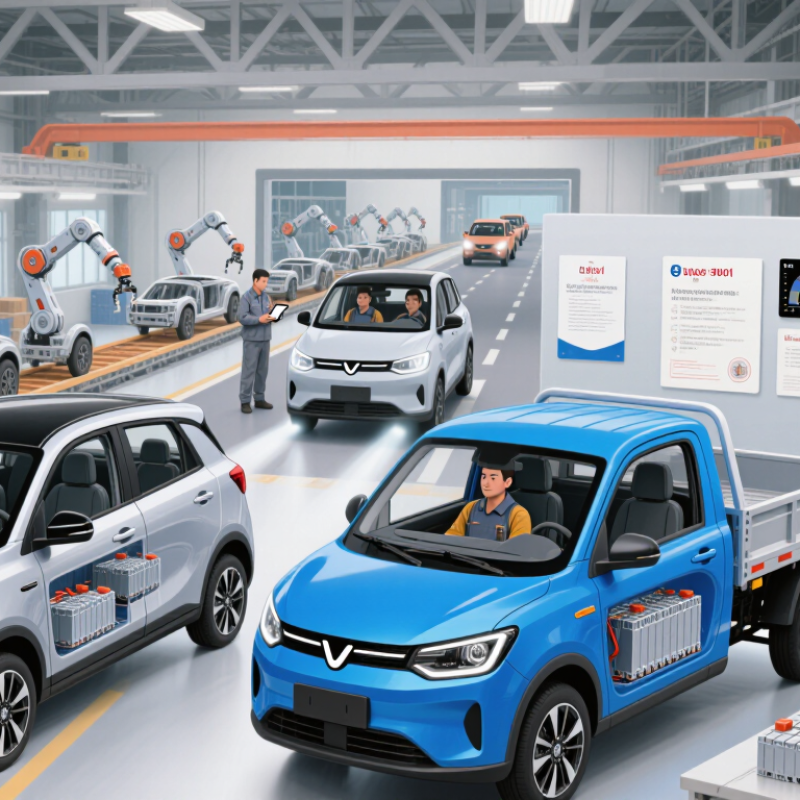
Choosing the China best L7e Quadricycle manufacturer requires more than comparing factory prices. Buyers should examine compliance, battery safety, driving range, component quality, and after-sales support. The European Union classifies L7e vehicles as heavy quadricycles under Regulation (EU) No 168/2013. Passenger models generally remain within a 15 kW maximum net power limit and a 450 kg mass limit, excluding batteries. These details affect certification, usability, and transport costs.
Market data shows why Chinese suppliers deserve careful attention. The International Energy Agency’s Global EV Outlook 2024 reported more than 8 million electric car sales in China during 2023. China also produced over half of the world’s electric vehicles that year. However, this data covers the broader electric-vehicle market, not only L7e Quadricycle products. That distinction matters. A large electric-car factory is not automatically an expert quadricycle manufacturer.
A reliable evaluation should combine documents with physical evidence. Request EU type-approval records, battery test results, ISO 9001 certification, and clear warranty terms. Inspect welds, door hinges, dashboard wiring, and the battery enclosure. Ask for range testing under realistic urban conditions, including cold weather and two occupants. The best manufacturer should explain cell chemistry, controller protection, spare-parts availability, and software updates without vague promises. CAAM data shows China’s new-energy vehicle sales reached about 12.9 million units in 2024, according to its annual industry release. That scale is impressive, but it can also hide uneven quality. No supplier is perfect. Factory visits, sample testing, and independent verification remain essential before signing a long-term contract.
An L7e quadricycle is a four-wheeled vehicle in the European L-category system. It is heavier and more powerful than a light quadricycle. Its continuous rated power generally cannot exceed 15 kW. The unladen mass limit is commonly 450 kg for passenger use and 600 kg for goods use, excluding batteries in electric models.
Unlike a conventional passenger car, an L7e vehicle is designed for short urban trips, narrow streets, and practical low-speed transport. Its compact body may fit into small parking spaces. A typical cabin includes two seats, simple controls, strong lighting, and basic protection against weather. Some versions use electric drive systems, which can reduce local noise and maintenance needs. Yet battery weight affects range and handling. That detail is easy to underestimate.
Yet battery weight affects range and handling. That detail is easy to underestimate.
From a manufacturing perspective, a reliable L7e supplier should provide traceable materials, repeatable welding, battery safety documentation, and clear testing records. Braking performance, steering response, door strength, and electrical insulation deserve careful inspection. Factory experience matters, but paperwork matters too. A vehicle may look polished and still need better validation.
Regulations differ between countries, including registration, driving permits, safety equipment, and road access. Buyers should verify local requirements before placing an order. Testing a loaded vehicle on uneven streets can reveal weaknesses that photographs hide. Even experienced teams sometimes overlook seat comfort or winter battery performance. That is where honest feedback improves the next production batch.
The strongest reason is an integrated supply chain, not only a lower quotation. Chinese manufacturers often source motors, battery packs, controllers, and body parts nearby. This can shorten development cycles and simplify replacement support.
The IEA Global EV Outlook 2024 reported nearly 14 million electric cars sold worldwide in 2023. That figure excludes many L7e vehicles, but it shows strong demand for compact electric mobility. BloombergNEF’s Electric Vehicle Outlook 2024 projected 16.6 million passenger EV sales for 2024. The market is expanding, although L7e buyers need more specific evidence.
A capable manufacturer should provide battery test records, range results, charging data, and production quality controls. Ask for measurements taken under realistic loads, not ideal laboratory conditions.
A small quadricycle may travel through narrow streets, steep ramps, and cold mornings. Those details expose weak thermal management quickly.
Factory customization can also adjust seating, cargo layout, suspension settings, and charging interfaces. Yet customization may increase tooling costs and delivery time. That trade-off deserves honest discussion.
Tips: Request a sample vehicle, independent inspection, component traceability, and after-sales response times. Verify compliance documents for your target market. Do not judge quality from photos alone. A polished brochure proves very little.
Designing an L7e quadricycle begins with strict dimensional discipline. European Regulation (EU) No 168/2013 sets category limits for mass, power, and vehicle performance. For electric models, continuous rated power generally cannot exceed 15 kW. Passenger versions also face a 450-kilogram mass limit, excluding batteries.
Engineers usually build the frame with welded steel or aluminum sections. They test torsional stiffness before fitting doors, glazing, and suspension. Computer-aided design helps locate the battery low between the axles. This improves stability and leaves useful cabin space. The battery enclosure needs sealing, impact protection, and controlled thermal behavior. A battery management system monitors voltage, temperature, and cell balance. Production teams then inspect welds, torque values, insulation resistance, and brake performance at the end of each line. Small errors matter.
The IEA Global EV Outlook 2024 reported more than 14 million electric car sales worldwide in 2023. That figure does not measure L7e demand directly, but it shows stronger interest in compact electric transport. European type-approval requirements remain the practical reference for export-oriented factories. Reliable manufacturers should provide traceable materials, repeatable testing, and documented quality controls. In practice, the weakest point may be assembly consistency, not the original design. A clever prototype is insufficient when one loose connector reaches the road.
| Design and Production Dimension | Typical L7e Requirement or Engineering Data | How It Is Designed and Produced | Quality-Control Checkpoint |
|---|---|---|---|
| Vehicle Category | L7e is the European Union category for heavy quadricycles. It generally covers four-wheel vehicles with a maximum continuous rated power of up to 15 kW. | The vehicle platform is developed around a four-wheel chassis, low-speed urban operation, compact dimensions, and the applicable L-category type-approval requirements. | Confirm the target approval category before finalizing the chassis, motor, battery, braking, lighting, and safety systems. |
| Maximum Continuous Power | Up to 15 kW for the L7e category under EU Regulation (EU) No. 168/2013. | Engineers select a motor, inverter, cooling system, and gear reduction that remain within the approved continuous-power limit while providing sufficient launch torque. | Motor dynamometer testing, controller parameter verification, thermal testing, and review of rated-power documentation. |
| Mass Limit | Maximum mass in running order is generally 450 kg for passenger quadricycles and 600 kg for goods-carrying quadricycles, excluding the mass of batteries for electric vehicles. | Weight targets are allocated to the frame, body, battery, suspension, glazing, interior, electrical system, and payload before prototype construction. | Weighing on a calibrated scale in the required running condition, followed by axle-load and payload verification. |
| Maximum Speed | L7e vehicles are designed for speeds above the L6e light-quadricycle limit of 45 km/h; the exact approved maximum speed depends on the vehicle configuration and market requirements. | The speed target is set through motor calibration, final-drive ratio, tire diameter, electronic speed control, and braking performance. | Controlled-road or test-track speed measurement, speedometer comparison, and software calibration audit. |
| Vehicle Layout | Common layouts include two-seat passenger vehicles and compact goods vehicles with a dedicated cargo area. | The battery and heavy components are positioned as low and centrally as practical to improve stability, usable cabin space, and axle-load balance. | Check seating, ingress and egress, cargo dimensions, turning clearance, center of gravity, and front/rear axle loads. |
| Chassis and Frame | A lightweight steel space frame, pressed-steel structure, or mixed metal structure is commonly used for small-series and mass production. | Computer-aided design and finite-element analysis are used to optimize torsional stiffness, mounting points, suspension loads, and manufacturability. | Dimensional inspection, weld quality inspection, coating-thickness measurement, and static load or torsional-rig testing. |
| Body Material and Manufacturing | Typical body options include painted steel panels, aluminum panels, or molded thermoplastic composite panels. | Production may use stamping, bending, injection molding, compression molding, robotic welding, adhesive bonding, and final paint or surface finishing. | Panel-gap inspection, surface-finish inspection, paint adhesion testing, corrosion protection review, and water-leak testing. |
| Electric Powertrain | Most new L7e designs use a battery-electric powertrain with a traction motor, inverter, reduction gear, onboard charger, and low-voltage electrical system. | The powertrain is matched to vehicle mass, gradeability, acceleration, regenerative-braking behavior, thermal limits, and intended daily mileage. | Insulation-resistance testing, high-voltage interlock verification, cooling-system testing, software diagnostics, and road-load validation. |
| Battery System | Battery capacity is selected according to vehicle mass, speed, grade, climate, charging access, and target range; no single capacity applies to every L7e model. | A battery-management system monitors cell voltage, temperature, current, state of charge, balancing, overcharge, over-discharge, and short-circuit protection. | Cell matching, pack voltage inspection, BMS communication testing, thermal monitoring, charging validation, and end-of-line insulation checks. |
| Suspension and Steering | Independent front suspension or a compact axle-based arrangement may be used, depending on payload, cost, handling targets, and packaging. | Spring rates, dampers, steering ratio, tire size, and alignment are selected for low-speed maneuverability and stable urban handling. | Wheel-alignment measurement, steering free-play check, suspension travel inspection, and durability testing over representative road surfaces. |
| Braking System | A hydraulic or mechanically actuated service brake system may be combined with regenerative braking on electric versions. | Brake sizing considers vehicle mass, tire grip, speed, grade, heat dissipation, parking-brake requirements, and electrical failure conditions. | Brake-force balance, stopping-distance, parking-brake, fade, wet-braking, and hydraulic-leak tests. |
| Lighting and Electrical Equipment | Road-legal lighting, direction indicators, reflectors, warning devices, mirrors or camera systems, and instrument displays are selected for the destination market. | A protected wiring harness is routed away from heat, sharp edges, moving parts, and water ingress points, with connectors specified for automotive use. | Functional testing, connector retention checks, fuse and relay verification, electromagnetic compatibility assessment, and water-ingress inspection. |
| Prototype Development | A production-ready program normally progresses through computer-aided design, engineering prototypes, verification prototypes, and pilot-production units. | Design changes are controlled through drawings, bills of materials, software revisions, engineering-change notices, and test reports. | Design-review sign-off, traceable test results, repeatability checks, and confirmation that the pilot vehicle matches approved specifications. |
| Assembly Process | Typical stages include frame preparation, suspension installation, wiring, battery and powertrain installation, body fitting, interior assembly, fluid filling, and software commissioning. | Standardized work instructions, torque specifications, dedicated fixtures, barcode traceability, and controlled assembly sequences reduce variation. | Torque-record verification, connector inspection, fastener marking, leak testing, diagnostic scanning, and visual inspection at each station. |
| End-of-Line Testing | Every completed vehicle should be checked for basic electrical, mechanical, functional, and safety-related performance before shipment. | The final inspection sequence combines diagnostic-tool testing with controlled checks of brakes, steering, lights, charging, drive operation, noise, and water sealing. | Vehicle identification, fault-code scan, brake test, wheel alignment, charging test, lighting test, road test, and release approval. |
| Compliance and Market Approval | Requirements vary by destination. European L7e approval is based on the applicable EU vehicle type-approval framework, while other markets may use different national rules. | The manufacturer prepares technical documentation, component certificates, test evidence, conformity records, and production-conformity procedures for the target market. | Independent technical-service testing, document review, approval-body assessment, and continuing production-conformity audits. |
| Supplier and Manufacturer Evaluation | A capable manufacturer should demonstrate traceable materials, stable production processes, battery safety controls, documented testing, and after-sales support. | Supplier qualification, incoming inspection, process capability monitoring, corrective-action procedures, spare-parts planning, and warranty analysis are integrated into production management. | Review quality manuals, inspection records, sample test reports, production traceability, change-control procedures, and service response capability. |
Reference note: The regulatory figures above reflect the European Union L-category framework, particularly Regulation (EU) No. 168/2013. Exact requirements may differ according to the L7e subcategory, vehicle configuration, approval route, and destination market.
China Best L7e Quadricycle Manufacturer?
What Standards Should Buyers Evaluate?
A serious L7e evaluation starts with legal classification, not brochure language. Under EU Regulation 168/2013, passenger L7e vehicles generally require a maximum continuous power of 15 kW and an unladen mass below 450 kg, excluding batteries under defined conditions. Buyers should request homologation files, test reports, and production traceability. A certificate without matching vehicle specifications is weak evidence.
Battery safety deserves closer inspection. UNECE R100 addresses rechargeable electrical energy storage systems, while UNECE R10 covers electromagnetic compatibility. ISO 26262 and ISO 21434 provide useful engineering benchmarks for functional safety and cybersecurity, even where local rules differ. Ask for thermal propagation tests, insulation measurements, water-ingress protection, and battery-cycle data. Small vehicles still face serious risks.
Real-world usability matters. The IEA Global EV Outlook 2024 reported more than 14 million electric cars sold globally in 2023, representing nearly 18% of new-car sales. That figure shows electrification momentum, but it does not prove L7e demand. The segment remains different. Range claims may use ideal conditions. Payload, cold weather, gradients, and heating can reduce them sharply. Test independently.
Check welding consistency, brake performance, steering backlash, charging protection, spare-parts access, and warranty response times. Euro NCAP results can inform safety thinking, although quadricycles are not always assessed like passenger cars. A polished factory can still miss details. Supplier audits should include random vehicle sampling, not only prepared units.
China Best L7e Quadricycle Manufacturer?
Selecting the best manufacturer requires more than comparing factory prices. The IEA’s Global EV Outlook 2024 reports over 14 million electric car sales worldwide in 2023. CAAM also recorded 9.5 million new-energy vehicle sales in China that year. These figures show strong production experience, but they do not prove L7e expertise. The category needs separate verification.
Request technical drawings, payload calculations, battery test records, and production samples. Confirm whether the supplier understands your target market’s L7e approval requirements. Ask for evidence. Not promises. A capable factory should explain motor ratings, charging protection, braking performance, corrosion treatment, and cold-weather range in clear language.
Audit the assembly line personally or through an independent inspection agency. Check welding points, cable routing, battery sealing, spare-parts storage, and final inspection records. ISO 9001 certification is useful, but it cannot replace process evidence. Review at least three years of export experience and speak with existing commercial customers. The IEA notes that battery supply chains remain concentrated, so ask about cell traceability and replacement support. This is often overlooked.
A practical supplier should provide a pilot unit before mass production. Measure real range with passengers, hills, and repeated stops. Published range can be optimistic. I would also negotiate inspection rights, warranty response times, software update procedures, and delivery penalties. Price still matters, but an inexpensive quadricycle becomes costly when parts arrive late or field defects repeat.